The COVID-19 pandemic is impacting many aspects of all our lives, including our mental health. The mental health charity Mind has called the pandemic a mental health emergency. Unmind is a mental health platform that offers workplaces a tool to support their employees. They worked with academics and psychologists to develop a platform to provide mental health tools, training, and assessments.
The app covers a range of mental health subjects, including sleep, stress, productivity, and your ability to support others during a difficult time – all delivered in bite-sized chunks through audio, video, and interactive content. It has mobile and desktop options and uses simple, accessible language.
The role of employers in the new NHS test and trace service
The NHS test and trace service has been implemented to help manage the risk of the virus re-emerging as restrictions on everyday life in England are eased. But how does test and trace impact employers?
The government say that it is vital employers play their part by:
making their workplaces as safe as possible and
encouraging workers to heed any notifications to self-isolate and supporting them when in isolation.
The advice for employers is to continue to communicate with workers in self-isolation and provide support. This includes allowing people to work from home if they remain well and if it is practicable to do so. This might include finding alternative work that can be completed at home during the period of self-isolation.
If people can’t work from home, employers must ensure any self-isolating employee is receiving sick pay and give them the option to use their paid leave days if they prefer.
The NHS test and trace service will provide a notification that can be used as evidence that someone has been told to self-isolate.
An employee can ask to take their paid holiday for the time they’re off work, entitling them to full pay for the duration of their leave, as opposed to Statutory Sick Pay, if they choose.
The NHS test and trace service is designed to support businesses and economic recovery by:
providing testing for anyone who has symptoms of coronavirus, so that if they have been tested positive, they and their household member know to continue to self-isolate
helping to stop the onward spread of the virus in the workplace and wider society, so that fewer people develop coronavirus and have to self-isolate
enabling the government to go further in safely easing or lifting lockdown measures, as far as it is deemed safe to do so, thereby allowing the nation to return to normal as quickly as possible.
It is important the employers continue to protect the health and safety both of their workers and of other people who may be affected by their business, for example agency workers, contractors, volunteers, customers, suppliers and other visitors.
Employers must continue to follow health and safety workplace guidance for their sector such as:
making every reasonable effort to enable working from home as a first option
where working from home isn’t possible, identifying sensible measures to control the risks in the workplace
keeping the workplace clean, maintaining safe working separation, and preventing transmission through unnecessary touching of potentially contaminated surfaces.
The measures employers put in place to maintain social distancing will depend on their individual business circumstances, including their working environment, the size of the site and the number of workers. The guidance will support employers to make an informed decision.
The NHS test and trace service does not change the existing guidance about working from home wherever possible.
In recent weeks, supermarkets have faced unprecedented demand from customers worried about the implications of the pandemic. Many new measures have been implemented, such as placing limits on the number of the products a shopper can buy and introducing dedicated hours for the elderly, vulnerable, and for NHS and social care workers. The government have temporarily relaxed elements of competition law, enabling retailers to work together on contingency plans and share resources.
Supermarkets across the UK are innovatively adapting to the challenge presented by the COVID-19 outbreak. Waitrose have introduced a number of initiatives to provide support to our community. A £1 million Community Support Fund will be available to Waitrose shop managers to help those in need in their local communities. Such help could include setting up additional local delivery services to support the self-isolating, the vulnerable, the elderly and those looking after them; delivering boxes of the most essential items to local care homes and community groups, and donating products to create care packages for customers to share with vulnerable neighbours.
Coronavirus: ‘I applied and got a job three hours later’ applicant says as supermarkets hire thousands’ (sky news)
Britain’s supermarkets are recruiting thousands of temporary workers to cope with surging demand. Tescos, Sainsbury’s, Waitrose, Morrisons, Asda, Lidl, and Co-op have all announced recruitment drives. These offer excellent opportunities, particularly for school leavers, university students, and those who have sadly recently lost their jobs. You can apply for a temporary position with Waitrose here.
Team Juvo win ‘Best CREST Award’ presented by The Lord Mayor of Exeter
Talent abounds at Big Bang SW which is the South West’s schools largest celebration of Science, Technology, Engineering and Maths (STEM). Held at the University of Exeter on June 21st and organised by Education Business Partnership SW its impossible not to be caught up in an upward spiral of inspiration and STEM possibilities.
Almost 2000 students from across Cornwall, Devon, Somerset and Swindon and over 60 local, national and international organisations and sponsors, including Beckton Dickinson, Babcock International and Spirent arrived to showcase their work and inspire one another. An amazing ‘Mega Class’ in the form of an interactive science session for 500 students, led by the National Space Academy, took place in the Great Hall.
The prestigious Big Bang UK Young Scientists & Engineers Competition was one of many awards to be decided at this event. Camborne Science and International Academy (CSIA) were delighted that students attending Nexus, their Gifted STEM programme, won two awards. The Best Crest Award which was sponsored by Exeter City Council and awarded by The Lord Mayor of Exeter, herself a Maths & Physics graduate was won by team ‘Juvo’ (Latin for help, assist, aid) . Their project resulted from their desire to solve a problem: “We are Year 7s and we have first-hand experience of being new arrivals in a huge secondary school and needing some help finding our way around…”(Gabriel Almeida, Max Anthony and James Belshaw). Team Juvo came up with the concept of how schools could use technology to communicate better with students, staff and visitors with interactive screens positioned around the site. They thought through how essential it is to engage with students, staff and visitors by tailoring profiles containing a range of Apps to suit the three user groups. The interactive screens offered site maps, newsletters and school information accessible to all; to individual timetables, co-curricular activity information, school bulletin, CEOP (Child Exploitation and Online Protection) reporting, Google drive and more, accessible to students; with other specific Apps aimed at teachers. “It’s like a digital friend who is always there to help you …” (Gabriel, Max and James).
As part of the Nexus Co-Curricular Programme, students will be learning how to develop Apps and look forward to Juvo developing their idea further. Mira Oates, Nexus Co-Curricular and Primary Coordinator was understandably proud and excited by both the success of both teams. “Huge congratulations to all the students who took part and I am incredibly proud of them. I was quietly confident our students would win something because the quality of their ideas and their passion. The Juvo team have an excellent concept which I can genuinely see it successfully used in schools and other organisations”.(Mira Oates)
A full list of awards and the talented teams can be found here
L to R: Kate (Cosmic), Clare (Industrial Cadets), Bethany (Honiton Community College) and Josh Elliot-Smith (Uffculme School)
World-class Work Experience Graduations!
Cosmic are the first of our employers to host young people on ‘World-class Work Experience’ accredited placements through Industrial Cadets as part of our pilot study. Both Bethany and Josh were awarded their Silver Level certificates which detail the programme they undertook, assure the quality of the experience against national standards and add to their sense of achievement. Cosmic believe in investing in young people and developing talent. They already run very successful and sought after work experience placements but these are the first as part of this pilot study. Thank you!
Josh Elliot-Smith from Uffculme School said:
Doing work experience at Cosmic has been a really interesting yet a challenging week for me. I’ve found throughout that I’ve been pushed out of my comfort zone, and have come out the other side with new ideas and skills that I never would’ve thought I would get out of this week , and I’m sure will benefit me in the future. I would definitely recommend doing your work experience at Cosmic if you’re interested in any area of IT2.
Bethany Jacobs from Honiton Community College said:
My work experience at Cosmic has been so enjoyable. I have achieved so many new and different skills meanwhile improving in my weaker areas. Everyone has been so nice, welcoming and helpful throughout this week. I really enjoyed this week and this has given me an insight to my future. I recommend Cosmic to students wanting to develop their skills in business and IT for their work experience.
The experience of quality Work Experience is invaluable. We know that the more real-life experiences of the world-of-work young people have the less likely they are to have difficulty entering the work-place. Work Experience brings benefits to the young people, the host employers and us all in the longer -term. This pilot will consider the value of the Industrial Cadets nationally recognised accreditation to the young people and the employers.
Does your business require a high work ethic, low absenteeism and excellent attention to detail?
Despite many being keen to find work, more than 85% of people with learning disabilities (LD) or autism are unemployed. Many do not consider themselves disabled, some have mild disability issues, and the majority have untapped talents or skills that are desirable for employers.
Businesses that employ someone with LD can benefit from skills that include:
Reliability, conscientiousness and persistence
High levels of concentration
Accuracy, close attention to detail
Detailed factual knowledge and an excellent memory
Meticulous application of routine tasks
Traditional recruitment methods can often exclude those with learning disabilities, because individuals find it harder to communicate and understand. The Untapped Talent initiative is designed to help employers access this skilled and reliable workforce. This event will offer business tips on inclusive recruitment and answer concerns regarding employment law.
Fact: 7% of people with learning disabilities have a job. 65% want one.*
Untapped Talent: The Employer Benefits Business Breakfast
Join us at this business breakfast for HR experts and business owners.
Tuesday 5 July 2016
Hannahs, Seale-Hayne, Newton Abbot, TQ12 6NQ07.30 – 10.30am
Free full sit down breakfast
This event is kindly being hosted by the Exeter & Heart of Devon Employment & Skills Board
England’s working age population volume and rate compared with Devon’s rate.
Participants from thirteen local Public Sector employers met at the Met Office for an update on the Apprenticeship Levy and the introduction of mandatory employment targets which will come into effect in April 2017. Ben Neild’s first presentation set the scene for the morning, proposing that apprenticeships could help to grow and keep local talent of all levels as “getting talent is getting tough”. The agenda included four informative and inspiring presentations – links below:
A round table discussion followed around three questions which elicited a great deal of interaction and notes! Here is a brief summary:
Q1 How do you work together and share knowledge and information?
Local Public Sector employers do not work together although there are groups and networks to which they belong. In addition internal collaboration can be a problem.
Q2 What would a Gold Medal Standard look like?
A Gold Medal standard apprenticeship would meet the business need, reduce resistance to cultural change, maximise the levy payment, provide evidence to enable further development, enhance collaboration and provide the apprentice with a quality learning experience with opportunities for employment and progression, whilst receiving a decent wage.
Q3a What are your next steps?
The next steps are for organisations: to understand their business and training needs and what the levy and the targets mean for them; to communicate this to Senior Management and identify dedicated resource and/or apprenticeship champion; and to consider working with other organisations to aggregate demand in order to negotiate with Training Providers and to share apprentices.
Q3b How can the EHOD Employment and Skills Board (ESB) help?
The ESB can help by informing and influencing organisations and by linking organisations either through identifying existing networks or by providing a facility to do so or similar networking events.
More follow-up information about the event will be shared with participants. Please contact oenone.thomas@exeter.gov.uk or 01392 265344 if you would like more information.
The Government has recently announced significant changes to Apprenticeships from April 2017. The changes are quite complex and far-reaching including Apprenticeship funding and incentives, delivery and direction, content, infrastructure etc. The most prominent message is a commitment to “3 million quality apprenticeship starts in England over this parliament”. For large public sector employers engagement will be mandatory, targets will be set and a levy charged.
This event is for local public sector employers to help them plan for the implementation of the Apprenticeship Levy, targets and new processes. It is designed for employers who already employ apprentices and for those that will be new to it. The agenda includes:
Exeter & Heart of Devon Economic Update from Ben Neild, University of Exeter
The importance of the public sector to the local economy and an update on productivity.
Detailed briefing on Apprenticeships post 2017 from Richard Daulton, National Apprenticeship Service
The Employer Levy, the 2.3% Public Sector target, the Digital Apprenticeship Service, apprenticeship standards and funding.
‘Large organisations thinking on Apprenticeships post 2017’ from Ben Neild, University of Exeter
Moving to a systemic approach.
A private sector case study from Nigel Fenn from South West Water
Assessing your current situation, plotting skills gaps and future needs, new recruits and/or workforce development and establishing costs and targets.
Room for collaboration? A round table discussion chaired by Mark Shepherd (Chair of EHOD Employment & Skills Board)
Shared apprenticeships? Joint development of standards where they do not exist? Shared intelligence and information.
Lunch and networking
The Event Details:
It is essential to register for this event (see below). Due to The Met Office security requirements please note that non-British Nationals should have their passports with them. Please do not arrive unless you are representing a Public Sector employer and you have booked your place. Thank you.
Date and Time
25 May 2016 09.00 am for 09.30 am with lunch at 12.30 pm
Location
The Met Office, FitzRoy Road, Exeter, EX1 3PB
Cost
None. We are very grateful to the Met Office and to Exeter City Council for their support of this event.
Employers supporting the ‘Pass the Torch’ campaign at the ‘Tap into Top Talent’ business breakfast
Last week employers met at the ‘Tap into Top Talent’ business breakfast to hear about the Government’s proposed extensive changes to apprenticeships and their commitment to 3 million apprenticeship starts by 2020. As well as having the opportunity to meet with employers who are committed to growing their own talent through the apprenticeship route, employers were signposted to the latest sources of information on the Employer Levy, the targets which will be imposed on the Public Sector, the new apprenticeship standards which replace apprenticeship frameworks and the mechanisms which underpin everything. Links to this information can be found at the bottom of this page.
Since ‘Tap into Top Talent’ there have been more announcements and information.
Government 10% Top-up announced in The Budget
This week George Osborne announced that the government will apply a 10% top-up to monthly funds entering levy paying employers digital accounts, for apprenticeship training in England, from April 2017. Therefore all funds entering a levy payer’s account will be increased, with every £1 will be increased to £1.10 in value.
Frequently Asked Questions
The proposed changes to Apprenticeships from 2017 are significant, quite complex and far-reaching including funding and incentives, delivery and direction, content, infrastructure etc. Select this link Apprenticeship Levy questions answered
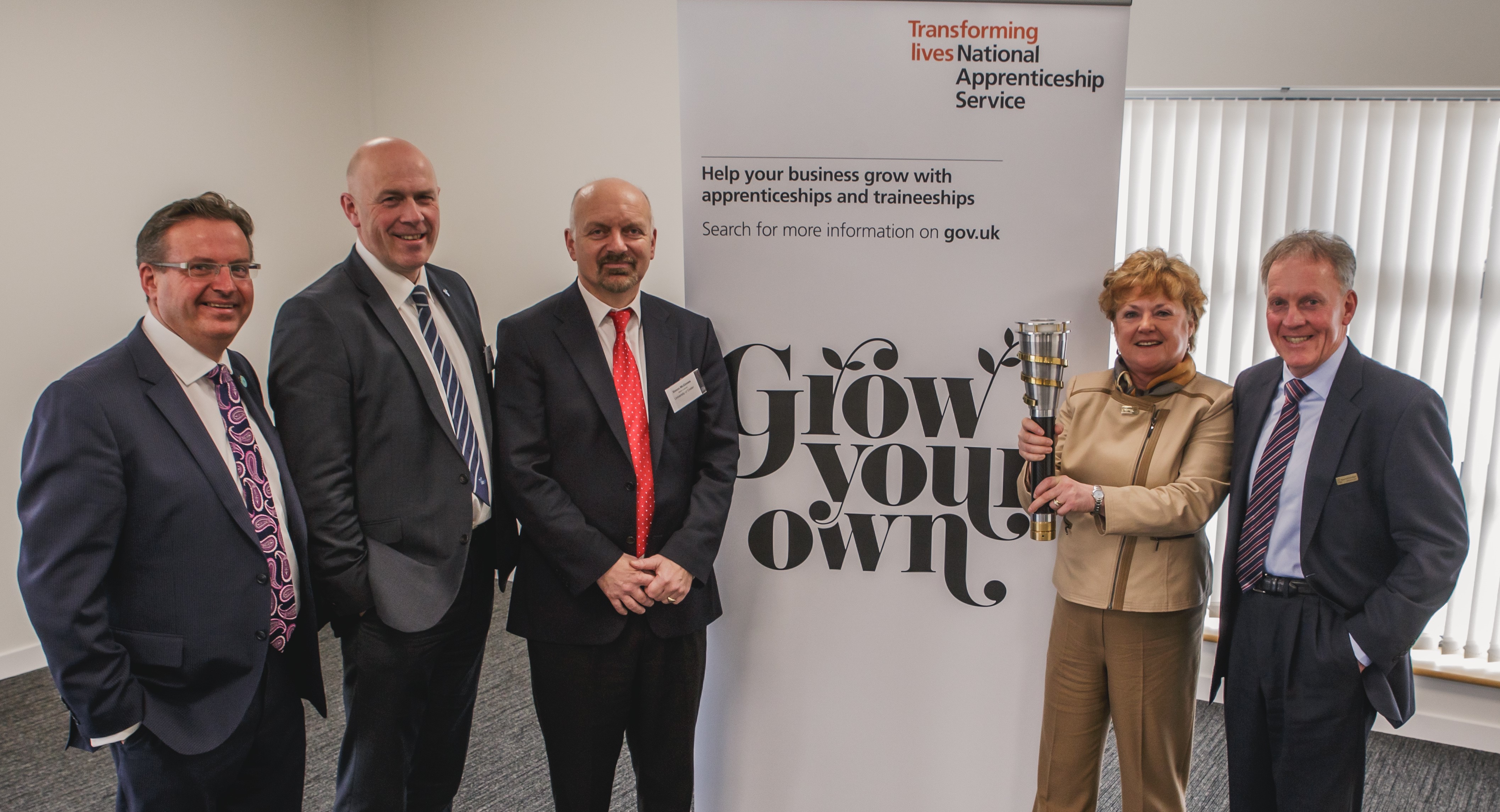
Mark Shepherd (Waitrose), Paul Gale (Interserve), Simon McGinnes (Univeristy of Exeter), Fiona Parsons (SWW) & Richard Daulton (SFA) with the Apprenticeship Torch
The Government have recently announced significant changes to Apprenticeships which will take effect in 2017. The changes are quite complex and far-reaching but the most prominent message is a commitment to ‘3 million quality apprenticeship starts in England over this parliament’.
The Business Breakfast
The Exeter and Heart of Devon Employment and Skills Board’s ‘Tap into Top Talent’ Business Breakfast on Friday 11th March was an opportunity for local employers to find out more about the benefits of ‘growing your own’ talent. Some employers had already benefitted from employing Intermediate and Advanced level apprentices and wanted to explore Higher or Graduate apprenticeships. Others new to apprenticeships and faced with the possibility of a levy wish to make the most of the changes. Whilst other businesses were particularly eager to find out about the new BSc Digital and Technology Solutions Degree Apprenticeships at the University of Exeter. The event included presentations from successful apprentice employers and the opportunity for a question and answer session with an expert panel. The event was part of the National Apprenticeship Week 2016 and kindly supported by Santander Corporate & Commercial Bank, at Pynes Hill, Exeter.
The Apprenticeship Torch
The ‘Apprenticeship Torch’ designed and made by apprentices to symbolise the passing on of knowledge made an appearance. The Torch was en route to an event at The Shard in London on Monday and then back to Exeter for the Apprentice Expo 2016 on Tuesday 15th March. Employers took the opportunity for a photo call with The Torch and to make pledges to make apprentices part of their workforce in the future.
Apprenticeships move with the times
Many apprenticeships today reflect the emerging sectors in the economy including information technology. However, as far back as the 1500s apprenticeships in England were developed around traditional trades such as paper-making and printing. Later in the late nineteenth century apprenticeships encompassed emerging sectors such as engineering and shipbuilding. Apprenticeships have always moved with the times. Now the Government plans a series to develop apprenticeships for a new era of increased productivity. It intends to make significant changes in 2017 which are likely to include:
Employers with a pay-bill of at least £3,000,000 will pay the Apprenticeship Levy at 0.5% of their pay-bill through HMRC.
Employers will be eligible for an allowance of up to £15,000 towards apprenticeship course fees. This funding will be managed through the Digital Apprenticeship Service and is made on a £2 Government : £1 employer contribution basis and has a defined life-time after which it will be lost.
Public Sector employers employing more than 250 people will be required to ensure that apprentices represent 2.3% of their workforce. A separate event in April will be help for Public Sector employers to find out more about this.
Many of these planned changes are still in the ‘melting pot’ but employers need to keep up-to-date. Plan to make apprentices part of the workforce either through formalising the training of existing employees or through recruitment so that you can make the most of the apprenticeship allowance, neutralise the cost of the levy if your paybill is over £3 million and meet the targets set for those in the Public Sector .











 Greater Exeter Skills Partnership