Preparing for a modern economy with Knowledge-Based Industries and a well qualified and highly specialised workforce at its heart, requires us to grow our own talent pool as well as attracting in-bound talent.
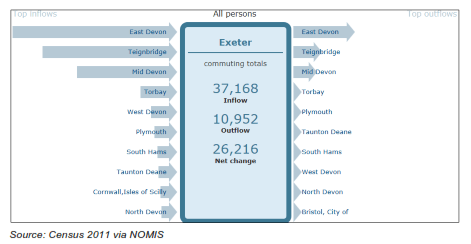
Around 50,000 people commute within the Greater Exeter Travel to Work Area every week day. People that live in East Devon may work in Exeter or Teignbridge and people that work in Mid Devon perhaps live in East Devon (see the diagram below). Children and young people travel considerable distances to learn too. The catchment area of some schools and colleges extends right across local council and sometimes county boundaries. Our ‘raw material’ for this talent pool needs to be nurtured from a young age regardless of the student’s or the school’s location, as inevitably we will all be working together, in an effort to make this region a great place to live and work.
Looking at the performance of schools and students is a sometimes a little like comparing ‘apples and pears’; up until 16 years ‘student residency’ is all important and at 18 years’ school location’ becomes the basis of the ranking. On the whole:
Primary school children, in most parts of the region, perform better than the national average.
Secondary school students performance at GCSE level (around 16 years) is more varied with GCSE results revealing a range of nearly 10% between the top performing and least well performing schools per council area.
Young people, are increasingly more mobile around about the age of 18, and tend to do well academically.
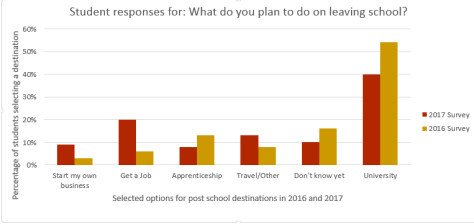
BUT then disappointingly the proportion progressing to Higher Education (HE) is notably lower than would be expected. Nationally, a decline of 4% in university applications has been recently reported. Closer examination reveals that this reduction is mainly in ‘mature’ students and in Nursing/Medicine/ Health related degrees where student tuition fees are no longer exempted. However, our small (124 students), local (South West), recent (June 2017) research exercise at a Big Bang SW indicates that 13% fewer school students intend to apply to university than the students surveyed in 2016 (see graph below). This is concerning as the proportion of young people progressing to Higher Education in EHOD is already notably lower than the national average.
Student debt (Tuition fee loans of up to £9250/annum plus maintenance loans are charged at 6.1% interest from this autumn) has been hitting the headlines and combined with economic uncertainty may have influenced a growing reticence amongst potential students to invest in themselves through HE. Surprisingly, and disappointingly, it appears that this reduction in HE applications may not result in a corresponding increase in students intending to undertake an apprenticeship, despite prominent Government campaigns and opportunities locally. Perhaps the messaging about university fees has been stronger than that of pro-Apprenticeships?
Accepting the research exercise was small and two years is not a trend, it is nevertheless interesting. Perhaps we are left with more questions than answers? At the very least this research indicates that more young people are certain about what they want to do. It may be that more young people want to be entrepreneurs, more want to get jobs (which does not and should not rule out learning), and that we all need to examine why local young people are less likely to apply to University and what can be done to increase the uptake of apprenticeships at every level. Working together is more likely to be the most successful approach. Whatever the route young people take, we want them to achieve their potential, to continue to learn and to contribute to a more modern economy and a happy community.
Korneel Verhaeghe – Partnership Development Officer from the University of Exeter writes:
This April marked the start of the new apprenticeship levy. Charged at 0.5% of payroll costs for UK employers with a wage bill of over £3 million, the Levy is part of the government’s commitment to create 3 million new apprenticeships by 2020. This creates new and interesting opportunities for organisations both large and small to recoup their costs or take advantage of government funding by hiring apprentices.
The University of Exeter has responded to this new opportunity with its pioneering BSc Digital and Technology Solutions degree apprenticeship launched in 2016, and more programmes on the horizon for 2017 and 2018.
A 2016 report showed the average UK student finishes their degree with £44,000 of debt, making degree apprenticeships a welcome opportunity for many talented and enterprising students looking to gain a degree without the burden of tuition fees. Through programmes of 4-5 years in duration, apprentices will gain a wealth of professional experience, earn a salary and enhance their lifelong career prospects. For employers, this offers new opportunities to attract high-calibre students while embedding them in the culture of your business, building loyalty and supporting growth.
This trailblazing programme at the University is benefitting from a mix of students and companies, ranging from IBM, Renishaw and the Met Office to smaller businesses such as Beran Instruments and Aspidistra Software.
“The combination of residential and remote learning, allows our degree apprentices to combine university studies with a real role at IBM. We’re confident they are learning valuable digital skills and look forward to seeing how much they will achieve.”
Charlotte Fisher Morecroft; IBM
The programme is delivered through a unique model of residentials and online study, created in such a way as to minimise the impact on apprentices’ roles in the workplace. Students travel from across the country to the Exeter campus twice a year for several days to kick-start new modules, while the rest of the year is taught through online learning and lectures. Recognising the value of the extensive real-wold experience gained by apprentices, approximately one third of credit towards the degree apprenticeship is assessed through work-based learning.
“As a business we really value the blended learning element of the course which allows our apprentices to take full advantage of the earn as you learn element of an apprenticeship.”
Emma Portman; Renishaw PLC
Students on the Digital and Technology Solutions programme go through 2 years of core teaching, before taking modules relating to the specialist role-related pathway they are appointed to. They graduate as either a Software Engineer, IT consultant, Business Analyst, Cyber Security Analyst, Data Analyst or Network Engineer.
Throughout their course apprentices are assigned a mentor in the organisation and an academic mentor from the University, allowing for close monitoring of their progress, academic and pastoral needs.
“We have found the Apprenticeship Programme to be very well structured, with ample support and information being provided at all stages, resulting in an enhanced learning experience, and enabling us to transfer and implement larger corporate ‘best practice’ within our smaller SME environment.
Our learners have clearly benefited from the excellent working relationships formed with a variety of professional and experienced people, both in terms of other students on the course and lecturers.”
Peter Morrish; Beran Instruments
Large and Small Companies
Companies with a wage bill over £3 million a year pay 0.5% of this (with a £15,000 exemption) into an online account on a monthly basis. They can choose to benefit from this levy by hiring apprentices, in which case the accumulated money will go towards the tuition fees.
Emma Portman, Test and Training Manager at Renishaw, has enjoyed working with the University in recent years:
“Starting an apprenticeship scheme can be a long, complicated process and even though Renishaw has a well-established degree-level software apprenticeship scheme it was with some trepidation that we embarked on our new supplier relationship with the University of Exeter. However, from the very beginning they were engaged, focused and enthusiastic. Our support team ensured that we had all of the information we needed quickly and our first cohort of apprentices joined the Digital and Technology Solutions degree successfully in September 2016.”
Companies not paying the levy can also benefit from this new system, as they will only pay 10% of the tuition fees, while the Government covers the remaining 90%. This provides smaller companies with a great and affordable way to grow their workforce, whether in number or in skill. Based on the BSc Degree Apprenticeship’s tuition fees of £27,000 over 4 years; this means small companies only pay £2,700 (10%); or £675 per year; to hire a new apprentice or to develop an already existing employee.
Beran Instruments, based in North Devon, currently has 1 student on the programme and has decided to hire another apprentice for the September 2017 intake. The company website boasts of their past success in hiring apprentices, some of which have now proceeded to managerial positions.
Peter Morrish, who joined the company in 1990 as an apprentice and is now a key member of the senior management team, cherishes the benefits of the degree apprenticeship on both the company and the student level:
“The Company has enjoyed various benefits from being involved with Exeter University’s Apprenticeship Programme, not least of which has been the significant level of development for the trainees as they have been able to apply theoretical learning to practical work applications from Day 1. The Company also benefits from improved access to a local high quality training provider, resulting in much greater communication and collaboration between the two organisations. The industry-focused modules relate closely to key business requirements.”
Students
The current students on the programme are very positive about the degree apprenticeship and see clear benefits to taking this route of vocational education:
“Being able to learn on the job while also learning at uni is great. As the course has progressed I’ve found that the knowledge is beginning to overlap and is reinforcing my learning on both sides. I’ve also learnt a lot about time management – you have to make sure you keep on top of everything, which at times can be challenging, like with any degree.”
The result of the degree apprenticeship programme is an experienced graduate, with a skillset moulded specifically to the needs of your business, which has shown to lead to increased loyalty to the company.
Quinten John joined Beran Instruments as an apprentice in 2011 and is currently on the IT degree apprenticeship at the University of Exeter. He explains how the programme is benefiting both him and the company:
“The flexible programme allows you to attend to work duties whilst learning in parallel, and enables you to specialise and develop particular skills to meet your own individual career aspirations and also the ongoing needs of the business.” Quinten John; Software Degree Apprentice – Beran Instruments
If you would like to explore how a degree apprenticeship can benefit your organisation, please get in touch with Partnership Development Officer Korneel Verhaeghe (01392 72 62 25 or k.verhaeghe@exeter.ac.uk), who will gladly provide you with information and answer any questions.
“The only thing worse than training your employees and losing them, is not training your employees and keeping them.”
Gemma – Carousel Apprentice with Cosmic, The Deer Park Hotel & River Cottage
Vicky Moss- Crump from Cosmic writes:-
Cosmic are advocates when it comes to apprenticeships. We took on our very first apprentice, Ben, in 1998 and he is still a valued member of the team. Since that time, apprenticeships have changed and Cosmic have evolved their offering to suit the needs of those looking for this type of work. In 2013, Cosmic secured funding to run their very own digital apprenticeship programme, which saw us employ six young people and gave us the opportunity to provide them with a wealth of digital knowledge. The apprenticeship enabled these young people to work on a variety of areas within our business. This includes website design and development, technical support, digital marketing and training; as well as the opportunity to gain placements with a number of our partners, including Mole Valley Farmers, Yarlington Housing and Eloquent Technologies.
Since then, we have been working with the Exeter and Heart of Devon Employment and Skills Board to look at different ways in which we can offer apprenticeships. We are all aware that there is currently a skills shortage within the digital sector. Many organisations recognise the need for digital within their businesses, but do not have the expertise to support these roles or do not need these roles on a full-time basis. With this in mind, Cosmic have designed an apprenticeship model which allows other organisations to benefit from Cosmic’s digital skills and offers a more flexible approach. We have called it the ‘Carousel Apprenticeship’.
In 2016, Cosmic held talks with several members of the Exeter and Heart of Devon Employment and Skills Board around this approach and it was agreed to move forwards with two other employers: The Deer Park Hotel and River Cottage.
So how does it work? Cosmic have employed a digital marketing apprentice; Gemma Spencer, who began the new programme in February 2017. Gemma attends college for 1 day a week and works at Cosmic for 1 day a week. During that time, she focusses on learning a range of digital marketing skills. She then works 1 day at the Deer Park Hotel and 2 days at River Cottage, allowing her to apply her learning to different organisations. The businesses benefit from a skilled digital apprentice and Gemma benefits from a wide range of learning through a number of organisations.
Already, Gemma is embracing the new way of working and has grasped the opportunity with both hands. She says, “I am looking forward to this new type of apprenticeship. Being able to work with different companies such as Cosmic, The Deer Park and River Cottage is a fantastic opportunity, giving me the chance to build strong relationships and gain as much experience as possible. One of the things I am looking forward to the most is being able to experience different working platforms, and interacting with so many different people. This will teach me to keep an open mind and have multiple perspectives for each company and their brand. Every day in the week will be something new with different surroundings and I’m more than excited for the opportunity”.
Joint CEO Julie Hawker said, “Cosmic has for many years made a major commitment to its own apprenticeship programme, and has offered new opportunities and employment to local young people. This new initiative to share our passion and commitment, as well as employment of apprentices with other local employers, is a fantastic development and one which we look forward to replicating many times in the years ahead.”
Managing Director of the Deer Park, Mark Godfrey advised “Deer Park are committed to the apprenticeship scheme and are proud of what we have achieved with our partners; River Cottage, Bicton College and Exeter College. We have had 6 apprentices working with us in the last 4 years and it’s great to see them all develop and move up the employment ladder with good qualifications.
We have been lucky enough to have apprentices from Bicton in our garden department growing produce for our River Cottage apprentices to cook for our 2 Rosette restaurant served by our Front of House apprentice from Exeter College. Now that’s a great example of plot to plate and growing your own!
And now working with Cosmic and River Cottage we have the great opportunity to have a Digital Marketing Apprentice working with us one day a week under a newly developed Carousel scheme, a fantastic opportunity for Gemma….”
All partners are delighted to be running this new programme and cannot wait to report on the programme at the end of 18th month scheme. Cosmic is extremely proud of the apprenticeships they have offered over the last 19 years. They will continue to look for new innovative ways in which to reduce the skills gap and enable other organisations to embrace technology through apprenticeships.
England’s working age population volume and rate compared with Devon’s rate.
Participants from thirteen local Public Sector employers met at the Met Office for an update on the Apprenticeship Levy and the introduction of mandatory employment targets which will come into effect in April 2017. Ben Neild’s first presentation set the scene for the morning, proposing that apprenticeships could help to grow and keep local talent of all levels as “getting talent is getting tough”. The agenda included four informative and inspiring presentations – links below:
A round table discussion followed around three questions which elicited a great deal of interaction and notes! Here is a brief summary:
Q1 How do you work together and share knowledge and information?
Local Public Sector employers do not work together although there are groups and networks to which they belong. In addition internal collaboration can be a problem.
Q2 What would a Gold Medal Standard look like?
A Gold Medal standard apprenticeship would meet the business need, reduce resistance to cultural change, maximise the levy payment, provide evidence to enable further development, enhance collaboration and provide the apprentice with a quality learning experience with opportunities for employment and progression, whilst receiving a decent wage.
Q3a What are your next steps?
The next steps are for organisations: to understand their business and training needs and what the levy and the targets mean for them; to communicate this to Senior Management and identify dedicated resource and/or apprenticeship champion; and to consider working with other organisations to aggregate demand in order to negotiate with Training Providers and to share apprentices.
Q3b How can the EHOD Employment and Skills Board (ESB) help?
The ESB can help by informing and influencing organisations and by linking organisations either through identifying existing networks or by providing a facility to do so or similar networking events.
More follow-up information about the event will be shared with participants. Please contact oenone.thomas@exeter.gov.uk or 01392 265344 if you would like more information.
The Government has recently announced significant changes to Apprenticeships from April 2017. The changes are quite complex and far-reaching including Apprenticeship funding and incentives, delivery and direction, content, infrastructure etc. The most prominent message is a commitment to “3 million quality apprenticeship starts in England over this parliament”. For large public sector employers engagement will be mandatory, targets will be set and a levy charged.
This event is for local public sector employers to help them plan for the implementation of the Apprenticeship Levy, targets and new processes. It is designed for employers who already employ apprentices and for those that will be new to it. The agenda includes:
Exeter & Heart of Devon Economic Update from Ben Neild, University of Exeter
The importance of the public sector to the local economy and an update on productivity.
Detailed briefing on Apprenticeships post 2017 from Richard Daulton, National Apprenticeship Service
The Employer Levy, the 2.3% Public Sector target, the Digital Apprenticeship Service, apprenticeship standards and funding.
‘Large organisations thinking on Apprenticeships post 2017’ from Ben Neild, University of Exeter
Moving to a systemic approach.
A private sector case study from Nigel Fenn from South West Water
Assessing your current situation, plotting skills gaps and future needs, new recruits and/or workforce development and establishing costs and targets.
Room for collaboration? A round table discussion chaired by Mark Shepherd (Chair of EHOD Employment & Skills Board)
Shared apprenticeships? Joint development of standards where they do not exist? Shared intelligence and information.
Lunch and networking
The Event Details:
It is essential to register for this event (see below). Due to The Met Office security requirements please note that non-British Nationals should have their passports with them. Please do not arrive unless you are representing a Public Sector employer and you have booked your place. Thank you.
Date and Time
25 May 2016 09.00 am for 09.30 am with lunch at 12.30 pm
Location
The Met Office, FitzRoy Road, Exeter, EX1 3PB
Cost
None. We are very grateful to the Met Office and to Exeter City Council for their support of this event.
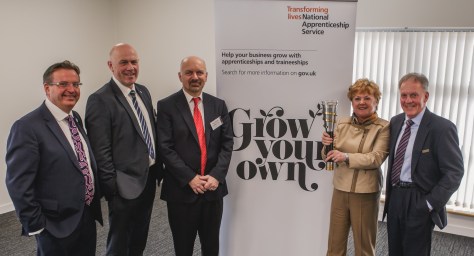
Mark Shepherd (Waitrose), Paul Gale (Interserve), Simon McGinnes (Univeristy of Exeter), Fiona Parsons (SWW) & Richard Daulton (SFA) with the Apprenticeship Torch
The Government have recently announced significant changes to Apprenticeships which will take effect in 2017. The changes are quite complex and far-reaching but the most prominent message is a commitment to ‘3 million quality apprenticeship starts in England over this parliament’.
The Business Breakfast
The Exeter and Heart of Devon Employment and Skills Board’s ‘Tap into Top Talent’ Business Breakfast on Friday 11th March was an opportunity for local employers to find out more about the benefits of ‘growing your own’ talent. Some employers had already benefitted from employing Intermediate and Advanced level apprentices and wanted to explore Higher or Graduate apprenticeships. Others new to apprenticeships and faced with the possibility of a levy wish to make the most of the changes. Whilst other businesses were particularly eager to find out about the new BSc Digital and Technology Solutions Degree Apprenticeships at the University of Exeter. The event included presentations from successful apprentice employers and the opportunity for a question and answer session with an expert panel. The event was part of the National Apprenticeship Week 2016 and kindly supported by Santander Corporate & Commercial Bank, at Pynes Hill, Exeter.
The Apprenticeship Torch
The ‘Apprenticeship Torch’ designed and made by apprentices to symbolise the passing on of knowledge made an appearance. The Torch was en route to an event at The Shard in London on Monday and then back to Exeter for the Apprentice Expo 2016 on Tuesday 15th March. Employers took the opportunity for a photo call with The Torch and to make pledges to make apprentices part of their workforce in the future.
Apprenticeships move with the times
Many apprenticeships today reflect the emerging sectors in the economy including information technology. However, as far back as the 1500s apprenticeships in England were developed around traditional trades such as paper-making and printing. Later in the late nineteenth century apprenticeships encompassed emerging sectors such as engineering and shipbuilding. Apprenticeships have always moved with the times. Now the Government plans a series to develop apprenticeships for a new era of increased productivity. It intends to make significant changes in 2017 which are likely to include:
Employers with a pay-bill of at least £3,000,000 will pay the Apprenticeship Levy at 0.5% of their pay-bill through HMRC.
Employers will be eligible for an allowance of up to £15,000 towards apprenticeship course fees. This funding will be managed through the Digital Apprenticeship Service and is made on a £2 Government : £1 employer contribution basis and has a defined life-time after which it will be lost.
Public Sector employers employing more than 250 people will be required to ensure that apprentices represent 2.3% of their workforce. A separate event in April will be help for Public Sector employers to find out more about this.
Many of these planned changes are still in the ‘melting pot’ but employers need to keep up-to-date. Plan to make apprentices part of the workforce either through formalising the training of existing employees or through recruitment so that you can make the most of the apprenticeship allowance, neutralise the cost of the levy if your paybill is over £3 million and meet the targets set for those in the Public Sector .
Over 50 Advanced Apprenticeships graduated at the Higher Apprenticeships Gradu8 2015 Ceremony at AugustaWestland Conference Centre in Yeovil on Wednesday 13th May which was full of fun, recognition and promise!
It was an exciting event where the Key Note Speakers:
Graham Cole CBE – Chairman AugustaWestland
Nigel Fenn – Organisation & Employee Development Manager South West Water
and Master of Ceremonies:
Rupert Cox – Chief Executive of the Royal Bath & West of England Show
were unanimous in recognising the hard work, dedication and success of the apprentices present. Indeed they made the apprentices, employers, training providers and their families were ‘the stars of the show’. To those receiving their awards Graham Cole said:
“The road you have taken can take you right to the top”.
The Government hopes that Apprenticeship Graduation Ceremonies will help raise the profile of Apprenticeships, putting them on an equal footing with a university route to success. Their ambition is for it to become the norm for young people to achieve their goals by going into an Apprenticeship or to university or, in the case of some Higher Apprenticeships, doing both!
REEP Young People are on track! They are demonstrating their determination, newly acquired skills and confidence, whilst continuing their valuable relationships with trained volunteer mentors. This is the latest update:
Aaron*
Is doing voluntary work at Hospice Care with a view to full time employment
Amy
Is working full time at Crealy
Charlie*
Has signed up for the Transplant course that is running this week, is doing his construction green card and forklift training
Charlie
Is working full time at IT company
Hamish*
Has been on work experience as a labourer and is currently in the process of trying to obtain his CSCS card
Jacob*
Is looking to sort his CSCS card
Jemima
Is working full time at Coach’s café, still trying to pursue further training for a Midwifery course
Mike*
Has applied for an apprenticeship in brick laying through Exeter College and hopes to hear this week
Ryan
Is sorting out an interview at the Job Centre today for Tool Hire
Importantly, for the local construction sector and for the young people themselves a large construction company are interested in meeting all the young people* who expressed an interest in a career in construction.
“Every individual matters” to the mentors, to the partners, to parents and carers, and now thanks to REEP to each one of the young people themselves.
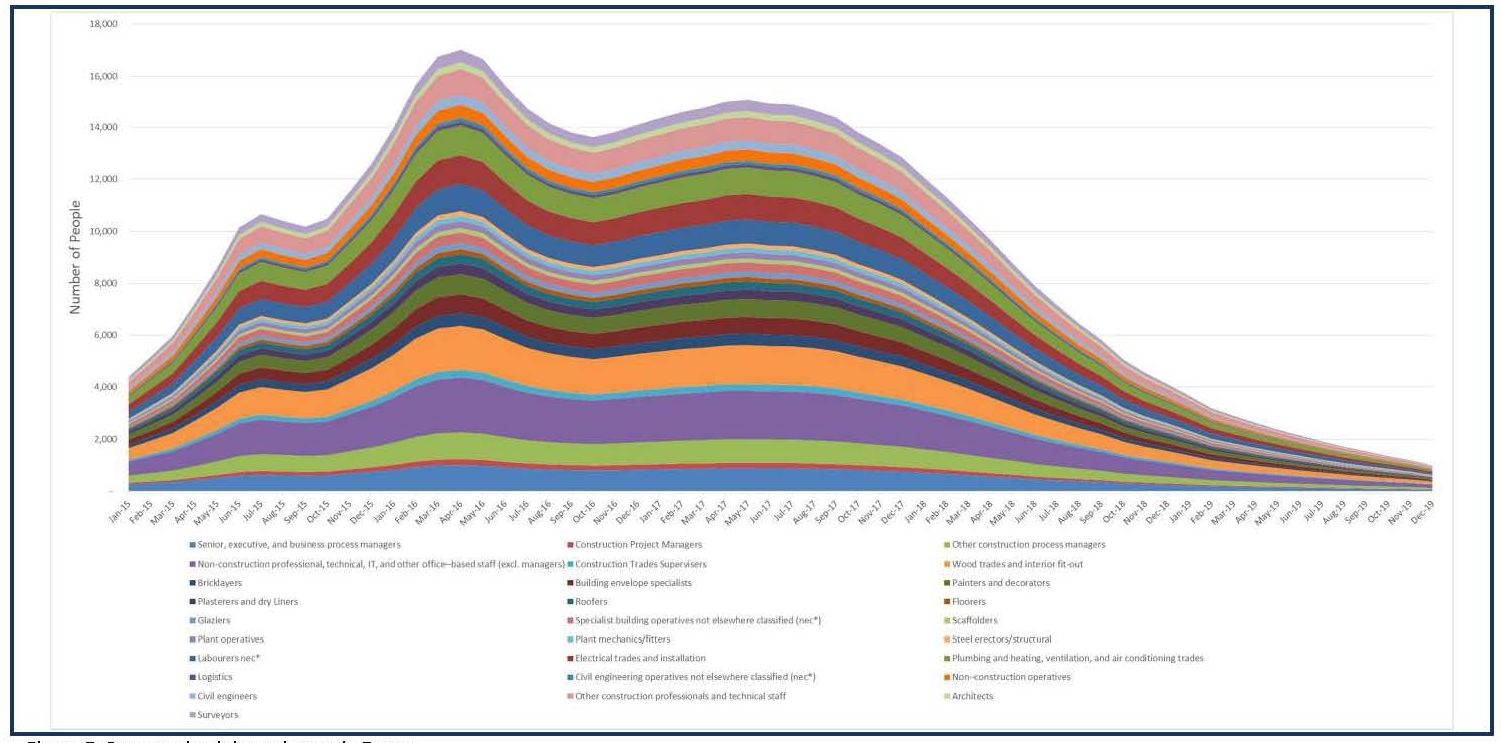
Heart of the South West Local Enterprise Partnership Labour & Skills Study January 2015 – Figure 3.6.1. Showing Labour Demand in Devon 2015-2019
Labour demand for construction workers in Devon is expected to increase from now until 2019, peaking at 17,000 workers in April 2016. At the moment there is a mismatch between labour supply and demand. So the challenge is to get the people with the right skills and knowledge in place to meet the workload. The dynamic is further complicated by planned re-development work in Plymouth and the construction of Hinkley Point C, the largest construction project in Europe.
Construction labour demand in the South West is expected to be 22,000 higher in 2019 than in 2014 representing an annual increase of 1.9%, higher than the UK average of 1.4%. Labour demand isn’t all about brick laying, it includes a huge spectrum of occupations:
Number of workers employed in a small sample of the 28 broad construction occupation groups (2014) for Heart of the South West (HoSW) (Devon, Plymouth, Somerset and Torbay)
Architects
830
Building envelope specialists
3,350
Electrical trades and installation
4,130
Non-construction professional, technical, IT, and other office-based staff.
9,500
Plumbing and HVAC Trades
6,200
Senior, executive, and business process managers
3,870
Wood trades and interior fit-out
9,140
The Exeter & Heart of Devon Employment and Skills Board (EHOD ESB) have been working with local councils and the Growth Point team to maximise the potential for recruitment of local skills development and labour. Council leaders from East Devon District Council, Exeter City Council and Teignbridge District Council have now signed a concordat to align their approach to construction skills development and employment opportunities. This will set the expectation that construction companies and their sub contractors, whether new build or for maintenance, will invest in local skills development in the same way across all three council areas.
Over the coming months we will be:
Supporting the newly formed South West Shared Apprenticeships, an organisation set-up to employ apprentices who are then allocated jobs within a number of construction companies and contractors. Over a number of projects and over a two-year period apprentices will accumulate enough experience to complete Level 1 and 2 NVQs. Thus, removing the barrier for some building companies, who do not have sufficient work to employ an apprentice full-time.
Working towards the implementation of the Construction Industry Training Board’s‘Client Based Approach’ which has clearly defined requirements in support of the development of a local skilled workforce through key performance indicators (KPI) for skills development and employment, commensurate with project type and scale.
Considering the benefits of a two stage procurement process through the Construction Framework South West for greater collaboration and localism.
Working with the Heart of the South West Local Enterprise Partnership and the Construction Industry Training Board to develop their construction employment and skills strategy.
The EHOD ESB has set out it’s mantra of ” Improving peoples’ lives through Employment and Skills whilst consciously reflecting that we are doing the right thing”. The size of the opportunity within the construction sector is significant. The proactive approach in tackling difficult challenges in an open forward-thinking collaborative approach, has begun to bear fruit, and it is vital that the momentum continues in order that the potential is realised.
Mark Shepherd, Chair of EHOD ESB said: “The success of this initiative so far, is a real credit to all those from Local Government, Employers, Funders and Facilitators whom without their contributions this would not have been achieved. For all partners this is a fantastic example of what proactive collaboration can achieve!”
Julie Hawker, Chief Executive, Cosmic, and Board member of the Exeter & Heart of Devon Employment & Skills Board writes –
We’re all very aware that most young people now in their teenage years come with a skill, experience and aptitude for IT and digital technologies ‘built in’. These millennials (born since 2000) have grown up in a world where digital has played a part in every stage of their lives so far – entertainment, healthcare, education, social interaction, communications and more.
At the very same time then consider how many businesses locally are desperately in need of new digital skills and the talent to harness its potential within the business. In fact, when asked most SMEs don’t yet know what digital technologies can offer to improve their businesses – they simply do not have the time, expertise and basic knowledge to start this type of review.
And then, there’s the dilemma which older teenagers are now facing: to go to university in order to develop their knowledge, skills and career opportunities (whilst at the same time racking up student debt of course), or have the courage to step straight into employment or work placement. Or, of course, get the best of both-worlds and find a great apprenticeship!
And so it was against this backdrop that Cosmic set out to develop our own digital apprenticeship programme – harnessing the potential which young people can offer for the growth of our business and partner businesses too. Our first step was to recruit the right individuals, and ideally to get the local schools working with us to provide the links to the recruitment process. Hugely disappointing reactions from these schools – unwilling to promote apprenticeships to students, too busy to share our flyers, or just not keen to interrupt other ‘priority’ school activities. And further disappointment in the balance of applicants when we finally did get enough response – why aren’t more girls interested in IT career paths at the moment?
Pie chart to show the lack of female applicants for digital apprenticeships at Cosmic
Once the recruitment was progressing, and during interviews, the inspiration and motivation levels for the project increased significantly, and we appointed six young guys with huge potential and commitment. During their 12 month programme we enjoyed watching them grow and develop new skills, become great team players, and more importantly take on income-generating roles in our business. We also provided them with major opportunities for work experience in partner organisations – Mole Valley Farmers, Yarlington Housing, Eloquent Technologies. And so the benefits to their development were very valuable.
And at the end of September 2014 Cosmic were able to offer three full-time, permanent roles on our staff – Jack, Alex, Jamie (one of whom already secured employment through the pilot project) are all now a part of the team and further developing their learning, skills and playing a part in business development too. Others who left us at this point have been supported to gain work in other businesses – web development and tech support. And so we look back at the programme with a great deal of pride and also a clear understanding about the value which this project gave us in return. For example –
Cosmic has now implemented a Living Wage policy – ensuring that the pathway from apprenticeship (lower paid) to permanent position also comes with a significant increase in wage levels to recognise the contribution made to the business
Travel costs to-and-from work are increasingly becoming a barrier for younger employees who seek to gain great jobs but at distance from home. Not just the cost of fuel if they are drivers, but the cost of insurance is massive! And then for those relying on public transport both the time it takes to journey across rural south west, and the costs involved are off-putting. (and so we put in place an additional travel subsidy based on the miles from home)
Harnessing young, enthusiastic talent in our business effectively is a challenge – we need structure, planning, quality management and customer focus. They need autonomy (freedom to choose), motivation, incentives, peer-support and (they need but may not want!) understanding how it fits in business – i.e. commercial awareness.
Customer service skills are not taught in our education system – and yet they are fundamental to every business! We invested a lot time with apprentices so that they learned and developed great customer service skills. Emails, phone calls, meetings, presentations all provide people with a link to our business and we must get that right every time.
Last month the House of Lords published a report about the significant need for digital skills to be embraced by British businesses – “Make or Break”
The report outlines numerous issues facing businesses and the need for digital skills, and plenty of recommendations for the incoming government in May to focus on –
“Including a digital element in all apprenticeship schemes, as well as offering more digital apprenticeships for specific technology occupations and sectors (taking into account the predicted changes to the labour market), could improve general digital skills”
But more locally, even the business community doesn’t recognise the major challenges ahead and we all need to inform and educate our colleagues and associates more fully. Digital skills will be needed by every business in the years ahead. There isn’t a ‘digital sector’ which will be the only employer of young talent, and we need to have schools, colleges, employers and careers support which understand this context for apprenticeships. And digital businesses and agencies, like Cosmic, are keen to sit at the heart of future developments and to support other employers.
Greater Exeter Skills Partnership is an independent body and voice for employers, aiming to improve employment across Devon and beyond.









 Greater Exeter Skills Partnership