
All posts by greaterexeterskills

YOUTH EMPLOYMENT UK’S EXCELLENT EMPLOYMENT & SKILLS SUPPORT FOR 14 – 24-YEAR-OLDS
Youth Employment UK is an independent, not for profit social enterprise founded in 2012 to tackle youth unemployment. They offer free skills & career activity booklets providing excellent resources for young people to use while considering their skills and future employment in these uncertain times. The free skills & careers activity booklet is available to download here.

These unprecedented times are having a profound impact on skills, jobs, and the economy. A report from The Resolution Foundation think tank found that youth unemployment could rise by 640,000 in 2020 – taking the total above one million. Supporting our young people in offering the right skills, resources, and networking opportunities have, therefore, never been more vital.
The free skills & careers activity booklet is an online editable tool with worksheets, including links to careers quizzes, a careers hub, job searches, and FAQs. The booklet covers:
- Young Professional – free online training
- Choosing a career
- Understanding the pathways available to you
- Boosting your skills
- Volunteering & work experience
- Employers & work
- Youth Voice Census
- Getting help
- Your Reflections
The Greater Exeter Skills Partnership will continue to highlight and to signpost to such excellent support.

Unmind: Providing vital mental health support in the workplace
The COVID-19 pandemic is impacting many aspects of all our lives, including our mental health. The mental health charity Mind has called the pandemic a mental health emergency. Unmind is a mental health platform that offers workplaces a tool to support their employees. They worked with academics and psychologists to develop a platform to provide mental health tools, training, and assessments.

The app covers a range of mental health subjects, including sleep, stress, productivity, and your ability to support others during a difficult time – all delivered in bite-sized chunks through audio, video, and interactive content. It has mobile and desktop options and uses simple, accessible language.

How will the NHS Test and Trace service impact employers?
The role of employers in the new NHS test and trace service
The NHS test and trace service has been implemented to help manage the risk of the virus re-emerging as restrictions on everyday life in England are eased. But how does test and trace impact employers?
The government say that it is vital employers play their part by:
making their workplaces as safe as possible and
encouraging workers to heed any notifications to self-isolate and supporting them when in isolation.
The advice for employers is to continue to communicate with workers in self-isolation and provide support. This includes allowing people to work from home if they remain well and if it is practicable to do so. This might include finding alternative work that can be completed at home during the period of self-isolation.
If people can’t work from home, employers must ensure any self-isolating employee is receiving sick pay and give them the option to use their paid leave days if they prefer.
Employees in self-isolation are entitled to Statutory Sick Pay for every day they are in isolation, as long as they meet the eligibility conditions outlined here: Information for employers on reclaiming Statutory Sick Pay.
The NHS test and trace service will provide a notification that can be used as evidence that someone has been told to self-isolate.
An employee can ask to take their paid holiday for the time they’re off work, entitling them to full pay for the duration of their leave, as opposed to Statutory Sick Pay, if they choose.
The NHS test and trace service is designed to support businesses and economic recovery by:
- providing testing for anyone who has symptoms of coronavirus, so that if they have been tested positive, they and their household member know to continue to self-isolate
- helping to stop the onward spread of the virus in the workplace and wider society, so that fewer people develop coronavirus and have to self-isolate
- enabling the government to go further in safely easing or lifting lockdown measures, as far as it is deemed safe to do so, thereby allowing the nation to return to normal as quickly as possible.
It is important the employers continue to protect the health and safety both of their workers and of other people who may be affected by their business, for example agency workers, contractors, volunteers, customers, suppliers and other visitors.
To help employers, guidance has been developed on the 5 steps for working safely, along with sector-specific guidance.
Employers must continue to follow health and safety workplace guidance for their sector such as:
- making every reasonable effort to enable working from home as a first option
- where working from home isn’t possible, identifying sensible measures to control the risks in the workplace
- keeping the workplace clean, maintaining safe working separation, and preventing transmission through unnecessary touching of potentially contaminated surfaces.
The measures employers put in place to maintain social distancing will depend on their individual business circumstances, including their working environment, the size of the site and the number of workers. The guidance will support employers to make an informed decision.
The NHS test and trace service does not change the existing guidance about working from home wherever possible.
Read further in-depth guidance on making sure your workplace is safe for your workers and others affected by your business.

Click here for the full government workplace guidelines for NHS track and trace, which should be used in conjunction with the regularly updated working safely during coronavirus guidelines.

Retail recruitment drive
In recent weeks, supermarkets have faced unprecedented demand from customers worried about the implications of the pandemic. Many new measures have been implemented, such as placing limits on the number of the products a shopper can buy and introducing dedicated hours for the elderly, vulnerable, and for NHS and social care workers. The government have temporarily relaxed elements of competition law, enabling retailers to work together on contingency plans and share resources.
Supermarkets across the UK are innovatively adapting to the challenge presented by the COVID-19 outbreak. Waitrose have introduced a number of initiatives to provide support to our community. A £1 million Community Support Fund will be available to Waitrose shop managers to help those in need in their local communities. Such help could include setting up additional local delivery services to support the self-isolating, the vulnerable, the elderly and those looking after them; delivering boxes of the most essential items to local care homes and community groups, and donating products to create care packages for customers to share with vulnerable neighbours.
Coronavirus: ‘I applied and got a job three hours later’ applicant says as supermarkets hire thousands’ (sky news)
Britain’s supermarkets are recruiting thousands of temporary workers to cope with surging demand. Tescos, Sainsbury’s, Waitrose, Morrisons, Asda, Lidl, and Co-op have all announced recruitment drives. These offer excellent opportunities, particularly for school leavers, university students, and those who have sadly recently lost their jobs. You can apply for a temporary position with Waitrose here.
Coronavirus (Covid-19) update and advice
The coronavirus Covid-19 pandemic presents unprecedented challenges for governments, businesses, and individuals across the world. You can find the most up-to-date government advice and support below.
Latest government advice and information
Stay at home.
Only go outside for food, health reasons, or essential work
Stay 2 meters (6ft) away from other people
Wash your hands as soon as you get home
Advice for employers
The Government’s business support website provides information on coronavirus related financial support, coronavirus related business support and wider business support. A number of new measures have been introduced to mitigate against some of the inevitable challenges the local, UK, and global economy will face. These include:
A Coronavirus Job Retention Scheme
The option to defer VAT and Income Tax payments
A Statutory Sick Pay relief package for small and medium sized businesses (SMEs)
A 12-month business rates holiday for all retail, hospitality, leisure and nursery businesses in England
Small business grant funding of £10,000 for all business in receipt of small business rate relief or rural rate relief
Grant funding of £25,000 for retail, hospitality and leisure businesses with property with a rateable value between £15,000 and £51,000
The Coronavirus Business Interruption Loan Scheme offering loans of up to £5 million for SMEs through the British Business Bank
A new lending facility from the Bank of England to help support liquidity among larger firms, helping them bridge coronavirus disruption to their cash flows through loans
The HMRC Time To Pay Scheme
There is also £500,000 of funding available for technology companies who come up with digital support solutions for people who need to stay at home because of coronavirus. You can find details of the scheme here.
Useful links
How to keep your employees safe
How to clean workplaces safely
Statutory Sick Pay (SSP): employer guide
Find out what to do for different businesses and organisations
UK businesses trading internationally
What the government is doing to help business
Extra protection for businesses with ban on evictions for commercial tenants who miss rent payments
Preparing for a modern economy
Preparing for a modern economy with Knowledge-Based Industries and a well qualified and highly specialised workforce at its heart, requires us to grow our own talent pool as well as attracting in-bound talent.
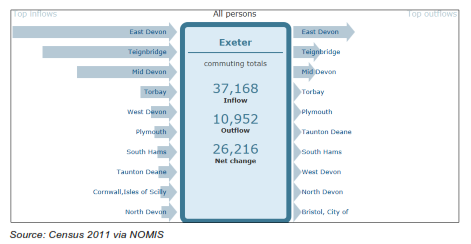
Around 50,000 people commute within the Greater Exeter Travel to Work Area every week day. People that live in East Devon may work in Exeter or Teignbridge and people that work in Mid Devon perhaps live in East Devon (see the diagram below). Children and young people travel considerable distances to learn too. The catchment area of some schools and colleges extends right across local council and sometimes county boundaries. Our ‘raw material’ for this talent pool needs to be nurtured from a young age regardless of the student’s or the school’s location, as inevitably we will all be working together, in an effort to make this region a great place to live and work.
Looking at the performance of schools and students is a sometimes a little like comparing ‘apples and pears’; up until 16 years ‘student residency’ is all important and at 18 years’ school location’ becomes the basis of the ranking. On the whole:
- Primary school children, in most parts of the region, perform better than the national average.
- Secondary school students performance at GCSE level (around 16 years) is more varied with GCSE results revealing a range of nearly 10% between the top performing and least well performing schools per council area.
- Young people, are increasingly more mobile around about the age of 18, and tend to do well academically.
BUT then disappointingly the proportion progressing to Higher Education (HE) is notably lower than would be expected. Nationally, a decline of 4% in university applications has been recently reported. Closer examination reveals that this reduction is mainly in ‘mature’ students and in Nursing/Medicine/ Health related degrees where student tuition fees are no longer exempted. However, our small (124 students), local (South West), recent (June 2017) research exercise at a Big Bang SW indicates that 13% fewer school students intend to apply to university than the students surveyed in 2016 (see graph below). This is concerning as the proportion of young people progressing to Higher Education in EHOD is already notably lower than the national average.
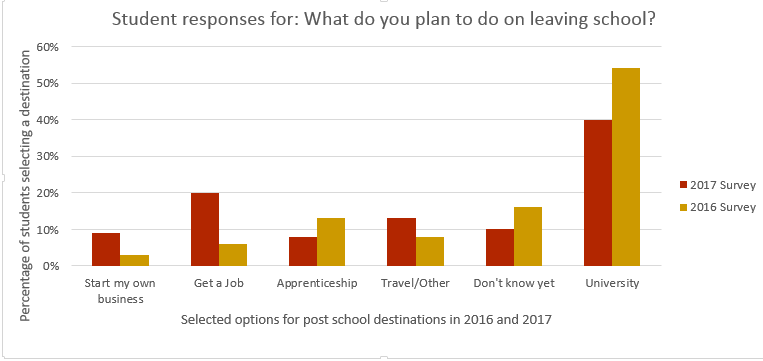
Student debt (Tuition fee loans of up to £9250/annum plus maintenance loans are charged at 6.1% interest from this autumn) has been hitting the headlines and combined with economic uncertainty may have influenced a growing reticence amongst potential students to invest in themselves through HE. Surprisingly, and disappointingly, it appears that this reduction in HE applications may not result in a corresponding increase in students intending to undertake an apprenticeship, despite prominent Government campaigns and opportunities locally. Perhaps the messaging about university fees has been stronger than that of pro-Apprenticeships?
Accepting the research exercise was small and two years is not a trend, it is nevertheless interesting. Perhaps we are left with more questions than answers? At the very least this research indicates that more young people are certain about what they want to do. It may be that more young people want to be entrepreneurs, more want to get jobs (which does not and should not rule out learning), and that we all need to examine why local young people are less likely to apply to University and what can be done to increase the uptake of apprenticeships at every level. Working together is more likely to be the most successful approach. Whatever the route young people take, we want them to achieve their potential, to continue to learn and to contribute to a more modern economy and a happy community.
Talent Abounds at Big Bang SW

Talent abounds at Big Bang SW which is the South West’s schools largest celebration of Science, Technology, Engineering and Maths (STEM). Held at the University of Exeter on June 21st and organised by Education Business Partnership SW its impossible not to be caught up in an upward spiral of inspiration and STEM possibilities.
Almost 2000 students from across Cornwall, Devon, Somerset and Swindon and over 60 local, national and international organisations and sponsors, including Beckton Dickinson, Babcock International and Spirent arrived to showcase their work and inspire one another. An amazing ‘Mega Class’ in the form of an interactive science session for 500 students, led by the National Space Academy, took place in the Great Hall.
The prestigious Big Bang UK Young Scientists & Engineers Competition was one of many awards to be decided at this event. Camborne Science and International Academy (CSIA) were delighted that students attending Nexus, their Gifted STEM programme, won two awards. The Best Crest Award which was sponsored by Exeter City Council and awarded by The Lord Mayor of Exeter, herself a Maths & Physics graduate was won by team ‘Juvo’ (Latin for help, assist, aid) . Their project resulted from their desire to solve a problem: “We are Year 7s and we have first-hand experience of being new arrivals in a huge secondary school and needing some help finding our way around…” (Gabriel Almeida, Max Anthony and James Belshaw). Team Juvo came up with the concept of how schools could use technology to communicate better with students, staff and visitors with interactive screens positioned around the site. They thought through how essential it is to engage with students, staff and visitors by tailoring profiles containing a range of Apps to suit the three user groups. The interactive screens offered site maps, newsletters and school information accessible to all; to individual timetables, co-curricular activity information, school bulletin, CEOP (Child Exploitation and Online Protection) reporting, Google drive and more, accessible to students; with other specific Apps aimed at teachers. “It’s like a digital friend who is always there to help you …” (Gabriel, Max and James).
As part of the Nexus Co-Curricular Programme, students will be learning how to develop Apps and look forward to Juvo developing their idea further. Mira Oates, Nexus Co-Curricular and Primary Coordinator was understandably proud and excited by both the success of both teams. “Huge congratulations to all the students who took part and I am incredibly proud of them. I was quietly confident our students would win something because the quality of their ideas and their passion. The Juvo team have an excellent concept which I can genuinely see it successfully used in schools and other organisations”. (Mira Oates)
A full list of awards and the talented teams can be found here
Spend to Save – why BEEP makes sense
Low cost but timely and profound interventions can prove to be worth ‘more than their weight in gold’. BEEP (Business Empowering Employment Programme) and REEP (Rugby Empowering Employment Programme) its forerunner can convert an initial investment of £550 to a potential saving of over £1 million in one generation.
Although, we may prefer to believe in the power of BEEP because it replaces despair with hope, confidence and potential, and alleviates inequality, we know that being able to make the economic case for ‘spending to save’ will win more support for BEEP. For this reason, and with help from Joe Walsh at Exeter City Council, we have developed a spreadsheet to calculate the cost of a variety of scenarios which illustrate ‘Spend to Save’. In order to do this we have made assumptions which are founded on information from reliable sources.
Young people who had struggled to find their way on to the training or work ladder, have through BEEP, together with support from their volunteer mentors, secured training and moved on to work which will benefit themselves, their communities and the local economy. The future looks positive for our apprentice bricklayer, our apprentice classroom assistant and our IT technician. But what if £550 hadn’t been spent and they had not been helped through the BEEP programme and by the volunteer mentors?

Joe says “By providing these individuals [BEEP mentees] with routes to employment the financial dependency on the state is considerably reduced and the money they earn will often be spent in the local economy on day to day goods and services.”
To find out more about BEEP how you can contribute and make ‘Spend to Save’ a reality please visit the BEEP website
Degree Apprenticeships at the University of Exeter

Korneel Verhaeghe – Partnership Development Officer from the University of Exeter writes:
This April marked the start of the new apprenticeship levy. Charged at 0.5% of payroll costs for UK employers with a wage bill of over £3 million, the Levy is part of the government’s commitment to create 3 million new apprenticeships by 2020. This creates new and interesting opportunities for organisations both large and small to recoup their costs or take advantage of government funding by hiring apprentices.
The University of Exeter has responded to this new opportunity with its pioneering BSc Digital and Technology Solutions degree apprenticeship launched in 2016, and more programmes on the horizon for 2017 and 2018.
A 2016 report showed the average UK student finishes their degree with £44,000 of debt, making degree apprenticeships a welcome opportunity for many talented and enterprising students looking to gain a degree without the burden of tuition fees. Through programmes of 4-5 years in duration, apprentices will gain a wealth of professional experience, earn a salary and enhance their lifelong career prospects. For employers, this offers new opportunities to attract high-calibre students while embedding them in the culture of your business, building loyalty and supporting growth.
BSc Digital and Technology Solutions Degree Apprenticeship
This trailblazing programme at the University is benefitting from a mix of students and companies, ranging from IBM, Renishaw and the Met Office to smaller businesses such as Beran Instruments and Aspidistra Software.
“The combination of residential and remote learning, allows our degree apprentices to combine university studies with a real role at IBM. We’re confident they are learning valuable digital skills and look forward to seeing how much they will achieve.”
Charlotte Fisher Morecroft; IBM
The programme is delivered through a unique model of residentials and online study, created in such a way as to minimise the impact on apprentices’ roles in the workplace. Students travel from across the country to the Exeter campus twice a year for several days to kick-start new modules, while the rest of the year is taught through online learning and lectures. Recognising the value of the extensive real-wold experience gained by apprentices, approximately one third of credit towards the degree apprenticeship is assessed through work-based learning.
“As a business we really value the blended learning element of the course which allows our apprentices to take full advantage of the earn as you learn element of an apprenticeship.”
Emma Portman; Renishaw PLC
Students on the Digital and Technology Solutions programme go through 2 years of core teaching, before taking modules relating to the specialist role-related pathway they are appointed to. They graduate as either a Software Engineer, IT consultant, Business Analyst, Cyber Security Analyst, Data Analyst or Network Engineer.
Throughout their course apprentices are assigned a mentor in the organisation and an academic mentor from the University, allowing for close monitoring of their progress, academic and pastoral needs.
“We have found the Apprenticeship Programme to be very well structured, with ample support and information being provided at all stages, resulting in an enhanced learning experience, and enabling us to transfer and implement larger corporate ‘best practice’ within our smaller SME environment.
Our learners have clearly benefited from the excellent working relationships formed with a variety of professional and experienced people, both in terms of other students on the course and lecturers.”
Peter Morrish; Beran Instruments
Large and Small Companies
Companies with a wage bill over £3 million a year pay 0.5% of this (with a £15,000 exemption) into an online account on a monthly basis. They can choose to benefit from this levy by hiring apprentices, in which case the accumulated money will go towards the tuition fees.
Emma Portman, Test and Training Manager at Renishaw, has enjoyed working with the University in recent years:
“Starting an apprenticeship scheme can be a long, complicated process and even though Renishaw has a well-established degree-level software apprenticeship scheme it was with some trepidation that we embarked on our new supplier relationship with the University of Exeter. However, from the very beginning they were engaged, focused and enthusiastic. Our support team ensured that we had all of the information we needed quickly and our first cohort of apprentices joined the Digital and Technology Solutions degree successfully in September 2016.”
Companies not paying the levy can also benefit from this new system, as they will only pay 10% of the tuition fees, while the Government covers the remaining 90%. This provides smaller companies with a great and affordable way to grow their workforce, whether in number or in skill. Based on the BSc Degree Apprenticeship’s tuition fees of £27,000 over 4 years; this means small companies only pay £2,700 (10%); or £675 per year; to hire a new apprentice or to develop an already existing employee.
Beran Instruments, based in North Devon, currently has 1 student on the programme and has decided to hire another apprentice for the September 2017 intake. The company website boasts of their past success in hiring apprentices, some of which have now proceeded to managerial positions.
Peter Morrish, who joined the company in 1990 as an apprentice and is now a key member of the senior management team, cherishes the benefits of the degree apprenticeship on both the company and the student level:
“The Company has enjoyed various benefits from being involved with Exeter University’s Apprenticeship Programme, not least of which has been the significant level of development for the trainees as they have been able to apply theoretical learning to practical work applications from Day 1. The Company also benefits from improved access to a local high quality training provider, resulting in much greater communication and collaboration between the two organisations. The industry-focused modules relate closely to key business requirements.”
Students
The current students on the programme are very positive about the degree apprenticeship and see clear benefits to taking this route of vocational education:

“Being able to learn on the job while also learning at uni is great. As the course has progressed I’ve found that the knowledge is beginning to overlap and is reinforcing my learning on both sides. I’ve also learnt a lot about time management – you have to make sure you keep on top of everything, which at times can be challenging, like with any degree.”
Lucy Spiteri-Beale; Software Degree Apprentice – Renishaw PLC
The result of the degree apprenticeship programme is an experienced graduate, with a skillset moulded specifically to the needs of your business, which has shown to lead to increased loyalty to the company.
Quinten John joined Beran Instruments as an apprentice in 2011 and is currently on the IT degree apprenticeship at the University of Exeter. He explains how the programme is benefiting both him and the company:

“The flexible programme allows you to attend to work duties whilst learning in parallel, and enables you to specialise and develop particular skills to meet your own individual career aspirations and also the ongoing needs of the business.”
Quinten John; Software Degree Apprentice – Beran Instruments
If you would like to explore how a degree apprenticeship can benefit your organisation, please get in touch with Partnership Development Officer Korneel Verhaeghe (01392 72 62 25 or k.verhaeghe@exeter.ac.uk), who will gladly provide you with information and answer any questions.
“The only thing worse than training your employees and losing them, is not training your employees and keeping them.”
Zig Ziglar
 Greater Exeter Skills Partnership